
Tech
How To Sign-Out Netflix on Samsung LG TV Vizio Smart TVs


It’s a good habit to sign out of Netflix to secure Netflix accounts especially Rental places like hotels, Guest houses, and Airbnb.
If you want to log out Netflix App on your smart TV, use remote keys (press the subsequent key ) up, up, down, left, right, and up. This will pop up the sign-out choice on your screen.
Simple Steps to Sign Out of Netflix on a Smart TV
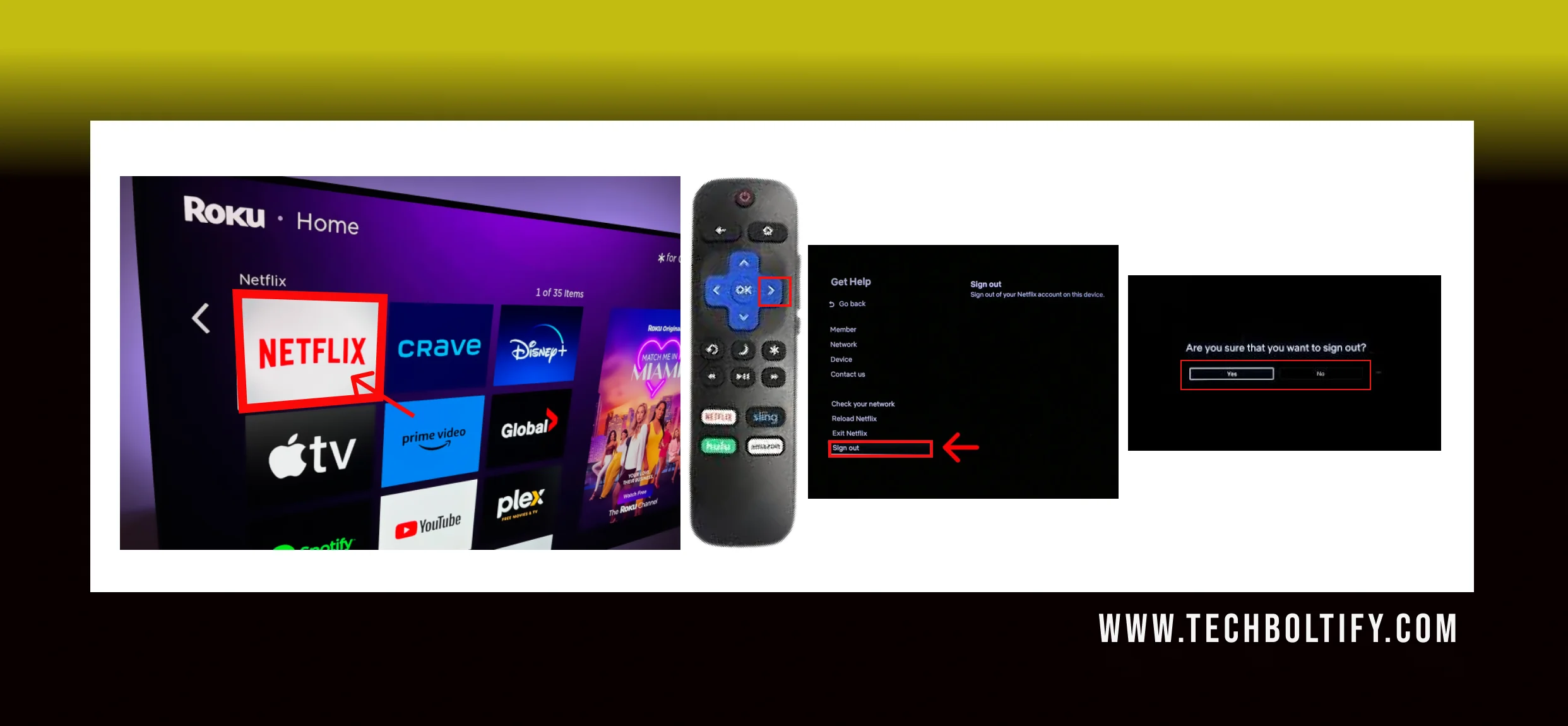
These steps help you to smoothly sign out of your Netflix account from any Smart TV:
- Click on the Netflix App on your Smart TV and open your Netflix profile.
- After the Netflix home page appears, press the left button on your TV remote.
- A sidebar menu appears. Now scroll down & select the Get help tab.
- scroll down and select to sign-out Tab.
- Verify that you want to sign out.
The page will refresh, showing the Get Started screen. The steps to log out of Netflix on a non-smart TV are the same as described above.
Logging Out of Netflix on Your TV from Your Laptop: A Step-by-Step Guide
If you have an issue with account access to the TV, your Netflix account is signed in on; Simply you can use a Desktop PC or laptop to sign out of your account. follow these simple steps:
- Type the Netflix website address on the address bar.
- Insert your Netflix login Username & Password.
- After logging in and viewing your profile, tap the profile icon located in the upper right corner.
- Click the drop-down menu and select Account.
- Now click on sign-out for all your devices.
- Verify your selection.
The above instructions ensure your Netflix account will be logged out from all devices, including smartphones, streaming devices, gaming consoles, and Smart TVs.
Signing Out Netflix Using Your Phone
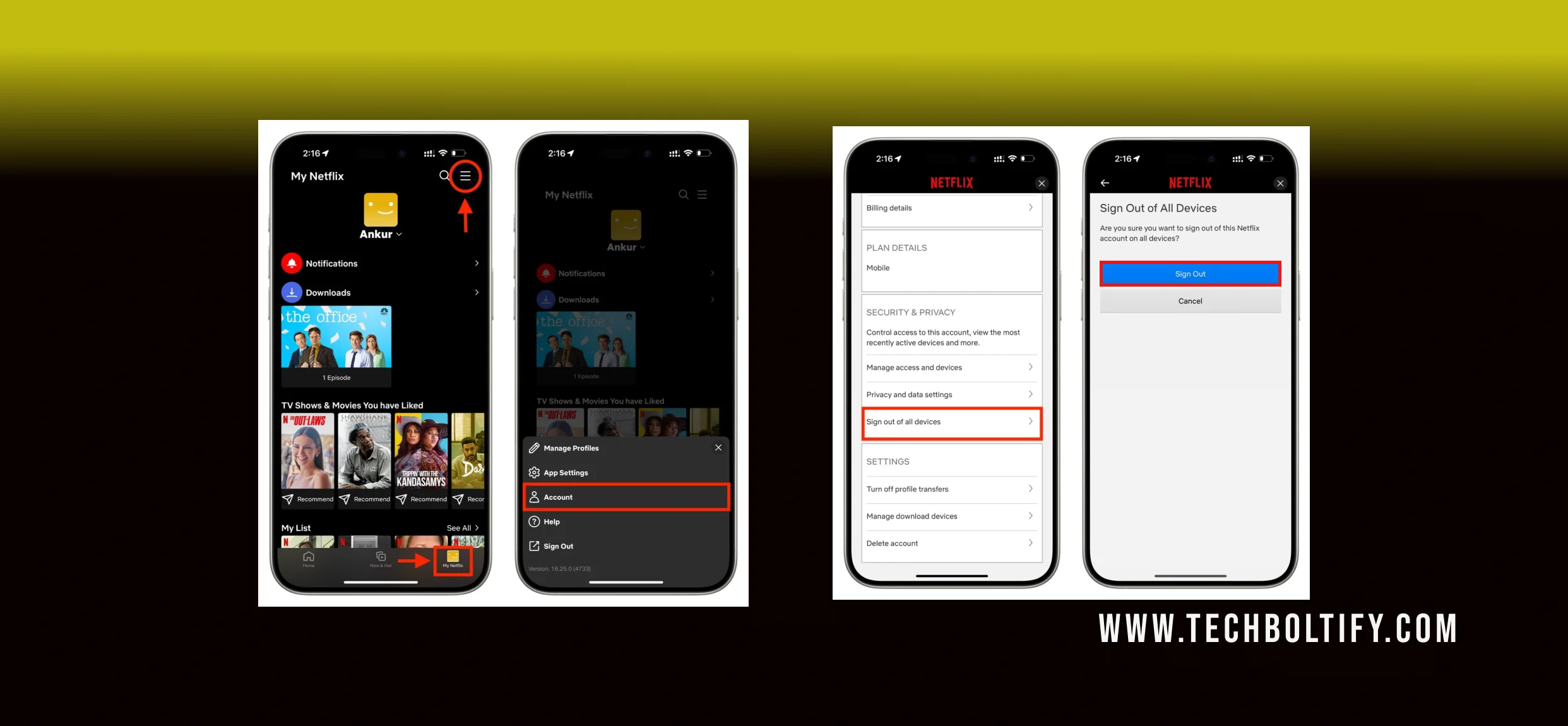
Simple and easy steps to log out of Netflix on your TV using your cell phone:
- 1. Open the Netflix app on your cell phone.
- 2. Look at the bottom toolbar, now click on more tabs.
- 3. Select sign out.
- 4. Now select sign out of all the devices.
If you’re using an iPhone, there isn’t an option to sign out of all devices directly. However, you can use Safari or another browser to accomplish this.
FAQs
What is Netflix?
It is a streaming platform that provides a list of movies, TV series, documentaries, and others besides. You can watch these on your home Smart TV, Personal Computer or a mobile device.
How do I log out from another person’s Netflix on my television?
To log out from another person’s Netflix on your television
- · Go to Settings
- · Select Advanced
- · Choose Deactivate Device
- · Confirm your choice.
Why can’t my Netflix log out from all the devices?
There are certain conditions when you can’t sign out of Netflix , you should be signed in your primary profile by default.
To do this:
- · First, go and open Netflix and sign in with your main profile.
- · Go to Account.
- · Move right down to the bottom to click on Sign out of all devices.
- · Confirm your choice.
Wrapping Up
If you are here, it means you were looking for directions on how to sign out Netflix on Samsung, LG TV, Vizio Smart TVs.
So here, we presented different simple and proven ways to sign out of Netflix. Be it your television, mobile, tablet or personal computer, we have you helpfully arranged with most used instructions.
You can actually have up to 5 profiles on a single account on Netflix so you can use it on different devices or allow your friends or family members to have their profile.
In case you left Netflix on your friend’s TV and forgot to sign out, you can sign out from all devices at once.
It is easy to log out of Netflix on your Smart TV.


Cybersecurity professionals have spent the past two years reorganising their work around a set of changes that arrived faster than most planning cycles allow for. AI systems that can take actions rather than only produce text are now running inside enterprise environments, and the controls built for conventional software do not map neatly onto them.
The response has not been to abandon existing practice. It has been to extend it, and to bring forward several pieces of work that were previously scheduled for later this decade.
This article covers the four areas where preparation is currently concentrated.
Treating AI agents as privileged users
The first shift is conceptual. An agent that can call APIs, modify files and access enterprise systems is not a piece of software in the traditional sense. It is closer to a user account with broad permissions and no judgement about who is instructing it.
The Australian Signals Directorate’s guidance on agentic AI harnesses addresses this directly. The harness is the software layer that connects a language model to data, tools and systems, and ASD identifies it as the component organisations can most realistically govern. Because prompt injection exploits how models process context, the mitigation has to sit in the harness, controlling what an agent can reach and what it is permitted to do.
In practice, security teams are applying familiar controls to an unfamiliar subject:
- Least privilege: Agent permissions restricted to the minimum needed for approved tasks, rather than broad access granted to reduce friction during a pilot.
- Human approval gates: Retained for high-impact or sensitive actions, with explicit limits on autonomous planning and execution.
- Logging and auditability: Comprehensive records of agent actions, decisions and tool usage, with mechanisms to interrupt or halt an agent mid-task.
- Third-party validation: Assessment of tools, integrations and dependencies before they are connected to anything that matters.
Using AI on the defensive side
The second shift is that defenders have started deploying the same technology. ASD has assessed that agentic AI has the potential to become a powerful force multiplier for cyber defenders, particularly in security operations centre automation, threat detection, vulnerability assessment and incident response.
This is already visible in tooling. ASD released Azul, its open-source malware analysis platform, publicly on GitHub in February 2026 to help network defenders analyse and correlate malware at scale. Commercial security vendors have moved in the same direction, with triage and enrichment work increasingly handled by automated systems so that analysts spend their time on decisions rather than collation.
The caveat attached to all of this is consistent. Agentic tooling used in defence carries the same risks as agentic tooling used anywhere else, which means defensive deployments need the same permission boundaries and oversight as any other.
Testing AI systems the way attackers would
The third area is adversarial testing. Red teaming has been standard practice for years, but the techniques that work against AI systems look very different from conventional penetration testing, because the attack is often written in plain language rather than code.
The OWASP GenAI Security Project’s 2026 assessment found that prompt injection remains the leading category of failure in agentic deployments, with excessive agency climbing sharply because that is where consequences now land. Its agentic risk list covers goal hijacking, tool misuse, memory and context poisoning, and insecure communication between agents, none of which appear in a conventional application security checklist.
Teams are responding by adding AI-specific test cases to release processes: attempting injection through documents, calendar invitations and repository metadata, and verifying that an agent cannot be talked into using a permission it holds for a purpose nobody authorised.
The quantum deadline running in parallel
The fourth piece of preparation has nothing to do with AI, but it is consuming a significant share of the same teams’ attention.
ASD recommends that organisations cease using traditional asymmetric cryptography by the end of 2030, including RSA, Diffie-Hellman, ECDH and ECDSA, replacing them with approved post-quantum algorithms. That is five years earlier than the equivalent NIST timeline. The interim milestones matter more than the endpoint: a refined transition plan by the end of 2026, and migration of critical systems underway by the end of 2028.
The end of 2026 is now close. Organisations that have not located their cryptographic dependencies and built an inventory are behind a schedule that the regulator has already published.
The skills the work requires
What ties these together is that none of them fits neatly inside one specialty. Securing an agentic deployment requires identity and access management, application security, threat modelling and governance at once, and the post-quantum transition is as much an architecture and procurement problem as a cryptographic one.
That combination is scarce. For technologists moving toward it, formal study remains a practical route, and programs such as an online master of cyber security from the University of Melbourne cover secure system design, cryptography, risk management and governance in a single structure rather than as separate certifications.
The fundamentals have not been displaced by any of this. Patching, access control, network segmentation and monitoring still prevent the majority of incidents, and the Five Eyes agencies have been explicit that AI-specific measures should complement established practice rather than replace it. What has changed is the number of things a competent security team is now expected to hold in view at the same time.
Selecting the right proposal automation software can lead to a substantial uptick in productivity for small business owners, reportedly increasing win rates by upwards of 28% and reducing proposal creation time by as much as 65%. Yet, deciding among the plethora of options in the market can be daunting without a clear set of criteria.
Assessing proposal software options requires careful consideration of your business’s unique needs, the usability of the software, its integration capabilities with your current systems, as well as cost and support structures. Below, we delve into the critical questions to steer your decision-making towards the best fit for your company

Before diving into the features of proposal automation software, it’s vital to delineate the specific needs of your business. The scale of operations, the complexity of proposals, and the industry regulations may dictate the level of sophistication you require from software.
To illustrate, a small consultancy firm may prioritize customization and client interaction features, while a construction company may need robust project estimation tools. proposal automation software Map out the proposal process you currently have and identify the bottlenecks or pain points that you intend to alleviate with automation.
Subsequently, identify the metrics you will use to measure success. Think in terms of return on investment, time saved in proposal creation, and improvement in response rates. This step will help you to set clear objectives for what the proposal automation software should achieve.
Evaluating the Usability and Learning Curve of Proposal Software
Usability remains a paramount consideration when selecting proposal automation software. The interface should be intuitive, with a gentle learning curve, especially since team members with varying technical proficiency will be utilizing it.
Investigating the availability of onboarding resources, such as tutorials, webinars, and customer support, can offer insight into how quickly your team can adapt to the new tool. Factors such as the availability of customizable templates can also significantly reduce the time taken to draft proposals. Look for platforms offering a comprehensive set of features conducive to productivity without overwhelming users.
Schedule demos or free trials to get hands-on experience with the software. This approach allows your team to assess firsthand how well the software aligns with your business workflow and the degree of technical support you might require.
Integrating with Existing Tools and Workflow Compatibility
Another crucial factor is the proposal software’s capacity to seamlessly integrate with your current tools and systems. Integration capabilities are essential for maintaining a cohesive workflow and avoiding data silos.
Assess whether the software can easily sync with your Customer Relationship Management (CRM) system, project management tools, and any other software that is central to your operations. This interconnectivity not only facilitates smoother data transfer but also maintains the integrity of analytics and reporting. Glance through customer reviews or case studies to gauge the integration successes of potential software choices.
During your assessment, note the flexibility of the software regarding custom integrations and APIs. This is important for tailored automation that resonates with your specific business processes, which in turn can lead to enhanced efficiency.
Understanding Pricing Structures and Support Options in Proposal Automation Software

The cost of proposal automation software can vary widely, and it’s not just about the upfront price tag. Small businesses should analyze the pricing structures, considering both short-term and long-term financial implications.
Understanding the subtleties between subscription models, one-time fees, and tiered pricing plans can help prevent budget overruns. Additionally, as the business grows, the scalability of the software should align with financial forecasts. Evaluate the availability and scope of customer support offered, which could range from email assistance to dedicated account managers, ensuring that help is readily available when needed.
It’s advisable to compare the total cost of ownership, factoring in setup fees, training costs, and any additional charges for updates or premium features. Make your decision with a clear picture of the investment and the value to be derived from the software in question.
Overall, the decision to invest in proposal automation software should be as deliberate and precise as the proposals your business generates. Take time to define your business needs, test for ease of use, verify integration with current systems, and scrutinize the financial commitments involved. With this strategic approach, you can select a platform that not only automates proposals but also catalyzes the growth and efficiency of your small business.
Privacy-focused storage and sharing platforms have grown rapidly as users seek alternatives to mainstream cloud services. One such solution is Anon Vault, which promotes anonymity and minimal data collection. While this model can be appealing, it also introduces a distinct set of risks and vulnerabilities that users should understand before relying on the platform for sensitive data.
Understanding Anon Vault and Its Core Promise
Anon Vault is typically positioned as an anonymous or privacy-centric vault for storing and sharing files. Its core value proposition often includes:
- Limited or no user identification
- Minimal logging policies
- Emphasis on anonymity and censorship resistance
While these features can enhance privacy, they can also weaken traditional safeguards found in regulated, enterprise-grade storage services.
Security Risks Associated with Using Anon Vault
Weak or Unverifiable Encryption Practices
One major risk is the lack of transparency around encryption standards. If digital privacy with AnonVault does not clearly document:
- Encryption algorithms used (e.g., AES-256)
- Key management processes
- End-to-end encryption implementation
users cannot independently verify whether their data is truly secure.
Increased Exposure to Malware and Malicious Files
Anonymous platforms are often attractive to threat actors. This raises the risk of:
- Hosting infected or malicious files
- Accidental downloads of trojans or ransomware
- Limited or nonexistent malware scanning
Without robust content moderation, users must rely entirely on their own security hygiene.
Privacy and Anonymity Vulnerabilities
False Sense of Anonymity
Anon Vault may advertise anonymity, but true anonymity is difficult to guarantee. Risks include:
- IP address logging by infrastructure providers
- Browser fingerprinting
- Metadata leakage during uploads or downloads
If users do not use additional tools (such as VPNs or hardened browsers), their identities may still be exposed.
Data Retention and Logging Uncertainty
When a service lacks clear policies, users face uncertainty about:
- How long files are stored
- Whether access logs exist
- If data is shared with third parties under legal pressure
This ambiguity can undermine the very privacy users seek.
Legal and Compliance Risks
Lack of Regulatory Oversight
Anon Vault may operate outside strict regulatory frameworks such as GDPR or SOC 2. This creates risks including:
- No guaranteed data protection rights
- Limited recourse if data is lost or exposed
- Unclear jurisdiction governing disputes
For businesses or professionals, this can be a critical compliance red flag.
Potential Association With Illicit Content
Anonymous platforms sometimes become linked to illegal file sharing. Even if you are a legitimate user:
- Your data may reside on shared infrastructure with illegal content
- Authorities could seize servers
- Service shutdowns could occur without notice
This can result in sudden and permanent data loss.
Reliability and Availability Concerns
Risk of Sudden Service Disruption
Anon Vault may be run by a small team or independent operators. Common risks include:
- Limited redundancy and backups
- Financial instability of the service
- Abrupt shutdowns or domain disappearances
Unlike major cloud providers, there may be no service-level guarantees.
No Formal Customer Support
Anonymity-focused services often provide minimal support. This means:
- No guaranteed recovery if you lose access credentials
- Slow or nonexistent responses to incidents
- No accountability for downtime
If access is lost, your data may be unrecoverable.
Usability and Human-Factor Risks
Irreversible Data Loss
Many anonymous vault services do not support:
- Account recovery
- Password resets
- Identity verification
If you lose your encryption key or access link, your data may be permanently lost.
Limited Integration and Features
Compared to mainstream platforms, Anon Vault may lack:
- Version control
- Collaboration tools
- Automated backups
This increases the risk of accidental overwrites or operational errors.
How to Reduce Risks When Using Anon Vault
If you choose to use Anon Vault, consider these mitigation strategies:
- Encrypt files locally before uploading
- Avoid storing mission-critical or irreplaceable data
- Use a VPN and privacy-focused browser
- Maintain offline backups in secure locations
- Review the platform’s documentation and community reputation
Anon Vault can be useful for low-risk, short-term, or non-critical data sharing, but it should not be treated as a fully secure or compliant storage solution.
Final Thoughts: Is Anon Vault Safe to Use?
Anon Vault offers privacy-oriented benefits, but those benefits come with trade-offs in security transparency, legal protection, and reliability. The primary vulnerabilities stem from anonymity itself: reduced oversight, limited accountability, and higher operational risk.
For users who value anonymity above all else, Anon Vault may be acceptable with proper precautions. For businesses or individuals handling sensitive, regulated, or long-term data, the risks often outweigh the benefits.
-
Tech2 years ago
AI and Freight Management
-

 Tech2 years ago
What is a Permission Controller – Control Manager Notifications
-

 Tech2 years ago
LPPe Service Android App and its Functions – How to Remove it
-

 Tech3 years ago
What is Device Keystring App On Android
-

 Tech3 years ago
What is Carrier Hub – How to Resolve Processing Requests Issues
-

 Tech2 years ago
What is Summit IMS Service – How to Stop Syncing on Your Android Device
-

 Tech2 years ago
Meta App Manager – What is Meta App Installer
-

 Tech2 years ago
What is Cameralyzer Samsung – How to Fix or Uninstall Cameralyzer on Android